


We have the pleasure to do a Ninja Gaiden Ragebound Review at Infinite Start, and honestly, it truly is a blessed moment in gaming and for fans of the original Ninja Gaiden Trilogy. The Game Kitchen, creators of Blasphemous, cooked yet again with another amazing game. At first, watching the trailer for this one as a fan of the original trilogy, I thought it would be just a modernized Metroidvania using the Ninja Gaiden namesake. I’m so glad that I was proven wrong, because the first thing this game does is give us the old cutscene treatment from the original Ninja Gaiden.
For those not in the know about gaming history, Ninja Gaiden is one of the first games to have cutscenes, to be precise, the game has around 20 minutes of them. Not only was it one of the few NES games to tell their story in-game, but it was also one of the first games ever to do so, it set the precedent for other games in the medium to show off. It was such a novel concept at the time that Tecmo themselves coined it as “Tecmo Theater”, and that “Tecmo Theater” comes back in Ninja Gaiden Ragebound too, adapted to modern capabilities.

The story happens at the same time as the NES original, and we are actually playing as someone that isn’t Ryu, but before we get properly introduced to that setting, the prologue leaves fans of the original trilogy with their mouths wide open. The cutscene shows us how Jo Hayabusa, father of Ryu, writes the letter that started Ryu’s journey before departing in his deadly mission to defend the Hayabusa Clan. The prologue acts as tutorial to get you familiarized with the controls, and we get to play a level that ends with the fabled NES intro scene, totally remastered and respectful to the vibe.
The style this game oozes is truly amazing, and it was expected coming from The Game Kitchen, they have very talented pixel artists and designers. This is what the Ninja Gaiden series should have been in an update, instead of becoming a perpetually brown game with the Xbox reboot of the early 2000s. Alas, modernization ends up converting original things into copies of whatever is the most popular at the moment, and Devil May Cry was all the rage back then. Ninja Gaiden Ragebound, being a proper side story and using the term “Gaiden” correctly, gets us into the shoes of Kenji Mozu, a pupil of Ryu who stays in Japan while he goes to America.

While Ryu is busy trying to defeat the Jaquio and his goons and traveling the world, Kenji tries to hold off a demon invasion that is currently happening in Japan. Unfortunately for Kenji, the demons end up outsmarting him, which leads him to engage in an unlikely alliance with a member of the Black Spider Clan, Kumori. We also get some back story as to why Kumori ended up with the same fate as Kenji, as we actually get to play as her too, and she is very fun to play with. The gameplay has been modernized, but the core DNA for the original NES trilogy is still there.
Some features present in the Xbox reboot also make an appearance here, namely the shop to buy talismans, but that’s as far as it goes. Linear levels make a return, some of them have secrets one can find, which is a first for a 2D Ninja Gaiden title, and a very welcomed thing to have. Ninja Gaiden Ragebound proves that the formula that got cooked in 1988 is still as new as ever, and with a few updates it can live on in our current times without issues.
It is a tough challenge to beat, albeit easier than the original NES trilogy, but for those who are perfectionists they will find tons of joy in clearing stages with the best rank. Going back to the gameplay, while it is the NES game at its core, there’s a big focus in mobility that evolves upon what was present before, as a ninja, you can climb through many surfaces, and this becomes a requirement to traverse many areas. Adding to this, the familiar Spinning Blade technique from the NES has been reworked as a mobility option, which allows you to use enemies as parkour elements.

Kenji is your typical Ryu Hayabusa kit, with the twist that he has greater mobility than him, much to the like on how Simon Belmont is stiff compared to Ritcher Belmont in Castlevania. One could compare Ninja Gaiden Ragebound with Castlevania Rondo of Blood, as there’s a ton of design ideas that feel inspired by it, being a true evolution to the classic formula, instead of a total genetic shift that was Ninja Gaiden Reboot. The most important aspect of Ragebound, is that you get to play as two different characters at the same time, in the body of a single one, truly a revolutionary mechanic that plays out smoothly.
Defeated, Kenji and Kumori form an unlikely alliance to attempt to save the world from the demonic invasion, which causes Kumori’s soul to live within Kenji by using the mystical heirloom of the Black Spider Clan. It was the only choice as both were in the verge of dying in the demon world thanks to their impulsive choices, the renewed Kenji has more abilities that are associated with Kumori’s skills, becoming both a deadly menace as a close range and ranged character. Kumori’s kunai and other abilities can be casted from afar at the cost of some of her soul energy, which can be collected by hitting enemies as Kenji.
The story takes many twists and turns, much to the like of the original NES trilogy, and it even improves by giving us a very important choice to make at the end. It is surprising the amount of detail that was put into the game, as there’s clear references that seem influenced by the old OVA. The soundtrack is also a love letter to fans of the series, with some new tracks that sound absolutely amazing, and a surprising guest appearance of Hitomitoi for a vocal song in the game. Bosses are as challenging as ever, but maybe not as hard as the ones present in the NES titles.
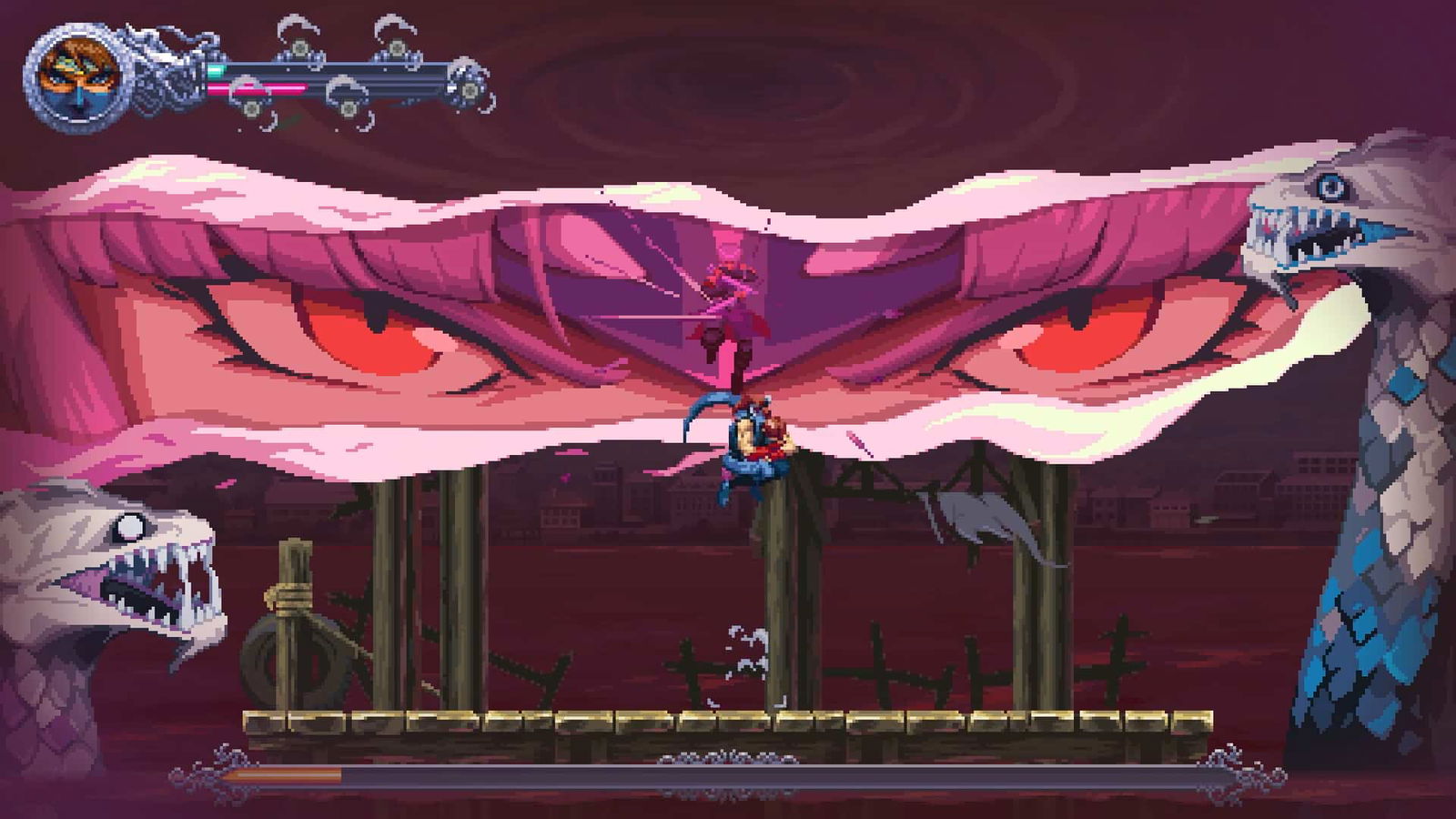
Despite that, they still offer some usual pattern memorization like the old days, coupled with the fact that the game really pushes you to use your newfound power to eliminate all demons. You even get to have critical hit attacks that can stun the bosses for a some time, while one hit killing big enemies that block your progress in a stage. Knowing how to traverse and using the stage at your advantage seems to be the main crucial element going on for this game, and the formula really shines here, this is something that not many action platformers do and it could very well be the identity of modern 2D Ninja Gaiden, if a sequel were to happen.
Ninja Gaiden Ragebound Review – Verdict
Ninja Gaiden Ragebound: Ninja Gaiden Ragebound is a proper evolution for the series, its amazing art, music, and even a full hard mode second run really makes it one of the best 2D Ninja Gaiden entries. There really is no flaws to be found in the game, aside from a cherry pick with Ryu using his modern design which feels out of place, but even then we don't really get to see him aside from the tutorial. To compensate that, we can even unlock skins to make Kenji look as if we were playing as the classic NES Ryu. Ninja Gaiden Ragebound satiated my need for more 2D Ninja Gaiden. – Hiro
[Editor’s Note: Ninja Gaiden Ragebound was reviewed on PC and a copy was provided to us for review purposes.]

